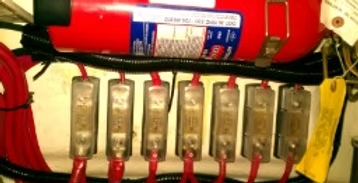
Bow Thruster Electrical Installation
We install the electrical side of a bow thruster: its high-current supply cables, protection, isolation, battery and charging arrangements, and controls. Hull openings, tunnel construction and other structural work belong to the yard. The electrical design follows the selected thruster’s requirements and the space and wiring aboard. It is not another small accessory circuit.
A thruster asks for substantial current during operation. The route from the battery to the motor, including the return, needs considering before equipment is ordered or lockers are altered. A control panel that lights up does not demonstrate that the power circuit can safely deliver what the motor needs.
Agreeing the boundary with the yard
Agree who is doing what so the yard work and electrical fitting join up properly. The thruster position determines where the heavy cables end; the chosen battery location determines where they begin. Share the thruster model and proposed layout before either part of the job becomes difficult to change.
We cover electrical design and fitting, not cutting the hull or constructing the tunnel. If the yard is arranging the mechanical side, identify access requirements and the sequence of work together. Our bow-thruster electrical guide explains the broader considerations, while the fitting service deals with the actual route, protection and controls on the boat.
Planning a short, protected supply route
Cable length and current both affect voltage drop. A long run can mean a much more demanding cable arrangement than the same motor installed close to its supply. The return conductor matters just as much as the feed; judging only the visible positive cable overlooks half of the circuit.
Space for bends, terminal access and support should be included in the route. Heavy cable must not rest on a sharp edge or pull on the motor connections. Our marine cable sizing guide explains why length matters. Selection for the installation follows the equipment requirements and the actual path, rather than guessing from a cable’s appearance.
Choosing protection and usable isolation
High-current circuits need protection suited to the conductors and equipment. Fusing is not chosen simply to stop nuisance operation; it must protect against faults without undermining normal use. The position of protection and the amount of exposed unprotected conductor need attention near the supply.
An isolation control should be accessible and clearly understood by the owner. It is not useful if reaching it requires working beside a damaged cable. Read the circuit-protection guide for background, but do not experiment by replacing a fuse with a higher rating. Heat damage or repeated fuse operation needs diagnosis, not a workaround.
Considering a dedicated battery and its charging
Depending on the boat and equipment, a dedicated battery near the thruster may be worth considering. That can alter the long high-current cable problem, but adds a charging arrangement, mounting and another bank to maintain. It is worth looking at, but not every boat needs one.
The battery chemistry and permitted current delivery must suit the motor. Charging needs to reach that battery correctly without compromising the other banks. If lithium is proposed, its discharge capability and management behaviour require particular attention. A battery with suitable capacity for lighting is not automatically a suitable source for a thruster.
Installing controls without confusing them with the motor feed
The helm controls and their cabling have a different role from the heavy motor circuit. They command operation but do not replace the power supply design. Their connectors, routing and any isolation relationship need checking against the thruster instructions, especially where an existing panel is being reused.
Position controls so their use makes sense at the helm without obstructing other equipment. Cable routes should remain identifiable after linings and lockers are refitted. Where a refit also includes a windlass, plan that high-current work together, while keeping the protection and needs of each circuit separate.
Checking operation and explaining the finished circuit
After fitting, check the circuit and watch the thruster work in suitable conditions. Supply behaviour, connections, protection and control response all matter. A motor turning briefly is not a reason to ignore heat at a termination or an unsuitable isolation arrangement.
For an enquiry, provide the thruster specification, battery location and photographs along the proposed route. Explain whether this is a new fitting or a replacement for equipment already aboard. Keep clear of exposed battery terminals and do not bridge controls to test an unfused temporary supply: high-current faults can cause fire and serious injury.
Frequently asked questions
Who makes the hull opening for a new bow thruster?
The yard handles the hull and tunnel work. Our service is the electrical installation, coordinated with the agreed thruster location and access.
Does a thruster always need its own forward battery?
Not always. A dedicated bank is one possible way to address the supply route, but it also needs appropriate charging and mounting. The actual boat and motor requirements decide.
Why assess the negative cable as carefully as the positive one?
Both carry the current when the thruster runs. A poor return cable can cause voltage drop or heating even when the positive cable looks heavy enough.
Can an existing helm control be kept with a replacement thruster?
Only after checking its compatibility and condition against the replacement equipment’s instructions. A familiar connector alone is not enough to establish that.
Should a repeatedly opening thruster fuse be increased?
No. Repeated fuse operation needs investigation of the load, circuit and protection selection. Increasing the rating without checking the installation can leave conductors inadequately protected.
- Bow thruster wiring explained
- Cable sizing and voltage drop
- DC circuit protection
- Ask about thruster electrics
- All services
Plan the power circuit before the fitting
Send the thruster model and pictures of the battery position and cable route.