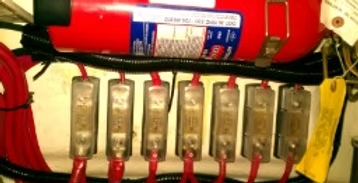
Marine Electrician in Emsworth
For a boat on a berth or mooring in Emsworth, we provide onboard electrical fault finding, surveys, battery upgrades and installation work. Emsworth sits within our Chichester Harbour coverage. Access in a tidal harbour needs discussing with the electrical job, especially where a boat uses a drying mooring rather than a walk-ashore berth.
Older boats can carry a mixture of original wiring and later additions. That history is not automatically a reason to replace everything, but it does make identification and inspection important. An electrical enquiry is most useful when it describes the current difficulty and shows the installation rather than guessing which component must be changed.
Planning the visit around a tidal berth or mooring
Tell us whether the boat is afloat, drying or ashore, how someone gets aboard and which compartments can be reached safely. Access arrangements may change with the tide. Discuss them before a visit is agreed so the electrical task can be considered alongside the practical route to the boat.
Do not move the boat solely to reproduce a fault or expose wiring for photographs. Describe the normal circumstances and any limits on access instead. Our Chichester Harbour page provides the broader coverage information; this page deals with the particular questions an Emsworth owner needs to settle when arranging onboard work.
Making sense of changes on an older boat
An unlabelled cable might supply equipment that is still essential, or it might be left from a removed installation. Tracing it matters before disconnection. Age alone does not tell you whether a circuit is sound: corrosion, chafe, terminations and appropriate protection are more useful things to examine.
An electrical survey can help establish what is safe to retain and where work should be prioritised. That is different from fixing just the circuit that is playing up. Send photographs of the distribution panel and visible connections, but leave live equipment closed and avoid disturbing uncertain conductors just to make the picture clearer.
Keeping charging decisions separate from battery guesses
A bank that loses charge may be suffering from standing loads, poor charging or its own condition. Those possibilities need separating before buying batteries. Note whether the problem follows time on the mooring, engine use or connection to shore power, because the charging source and consumption pattern affect the investigation.
If a lithium upgrade is planned, its supporting chargers and protection need review. Fogstar LiFePO4 fitting and Victron charging or monitoring are part of the services offered, but a particular product is not a cure for unidentified drain. The chosen bank should fit the way the boat is used and recharged.
Repairing what is faulty rather than changing everything
Electrical repair can involve connections, damaged conductors, switches or charging arrangements, as well as fitting replacement equipment when necessary. The reason for replacement should follow from what is found. A neat new panel will not cure an intermittent joint hidden further along the circuit.
Our electrical repairs page explains what we work on. Explain which equipment remains working and which does not; that distinction can be as useful as the fault itself. A symptom that appears after another load is switched on deserves investigation of the interaction rather than assuming straight away that the instrument itself is broken.
Preparing the boat and the information for the enquiry
Identify access to the bank, chargers and relevant cable runs. If lockers contain stored gear, explain whether it can be moved to reveal the installation. Include equipment model labels and any wiring information already kept aboard. Mention other work planned that could change access, without assuming it belongs within the electrical job.
Battery circuits can deliver dangerous fault currents, while shore power introduces mains shock hazards. Do not bridge a fuse, remove protection or open a live panel to investigate. If there is heat damage or a burning smell, stop using the affected equipment and discuss safe isolation and professional assessment.
Frequently asked questions
Which tidal-access details should an Emsworth owner include?
Explain whether the boat dries, how access is arranged and whether reaching the electrical compartments depends on its position or tide. Include those details when describing the fault or fitting job.
Must all original wiring be replaced on an older Emsworth boat?
Not solely because of age. Its condition, protection and suitability need assessment. Survey findings can distinguish wiring worth retaining from items requiring attention.
Is a flat bank after time on the mooring proof that new batteries are needed?
No. Consumption and the available charging must be investigated alongside battery condition. Replacing the bank before separating those causes may leave the problem unchanged.
Can a survey help prioritise several undocumented electrical additions?
Yes. An electrical survey examines the installation and reports faults, risks and priorities, helping you decide what to tackle first rather than treating every addition the same way.
- Chichester Harbour electrical coverage
- An electrical survey of the installation
- Repairing boat circuits and charging
- Send an Emsworth enquiry
- All services
Explain the boat’s access and electrical history
Send the symptoms, mooring arrangements and any existing wiring information.